
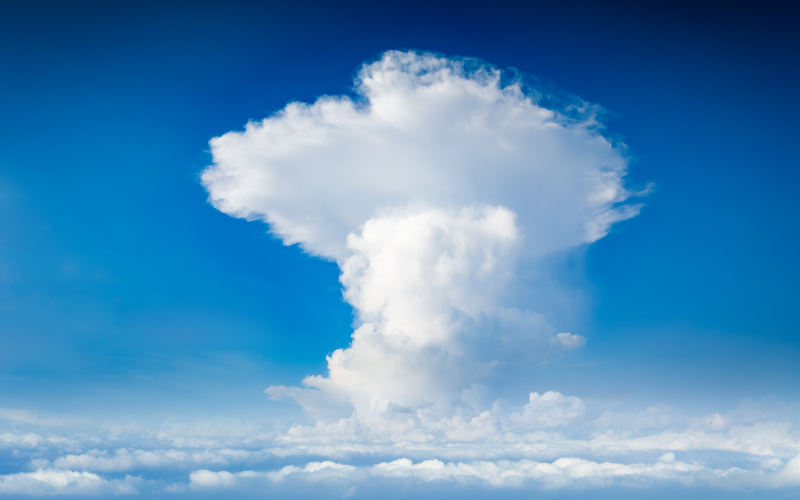
A cloud may look like a solid thing floating through the sky, like a beautiful scoop of whipped cream. But it is not; it just looks that way! In reality, cloud-gazing is more like watching a waterfall hang in the air. It turns out, the life of a cloud is rather complex and involved.
A small white cloud may begin as a faint blur above a field, then puff upward into a bright heap with a flat bottom and rounded top. Then, for a while, if you keep watching, you might see one edge start swelling while another edge becomes thin and ragged. And then ten minutes later, the whole thing rearranges itself. And, by evening, it might be completely gone. So what happened to it? And was it actually the same cloud from one minute to the next?
The answer isn’t straightforward because a cloud is not a fixed lump of water drifting through the sky. The components that make up a cloud are constantly appearing, disappearing, and being replaced.

Table of Contents
What Is a Cloud Made Of?
The air around you almost always contains water vapor, which is water in gas form. You can’t see it or feel it because it is smaller than mist or tiny droplets. It rises into the air from oceans, lakes, rivers, wet soil, and even plants.
On a sunny day, when the ground absorbs energy from the sun, it warms the air around it. Warm air is lighter than cool air, and it rises upward in loose bubbles. Picture carbonation bubbles floating up in a glass of soda. The air does the same thing.
As a bubble of air climbs, it cools, and the higher it goes, the colder it gets. Eventually, the rising air reaches its dew point, the temperature at which it is holding as much water vapor as it can at that temperature. It’s like how a glass of lemonade on a hot day has beads of water on the outside. That happens because the air next to the glass cools to its dew point, and when it does, the water vapor turns liquid.
When a rising bubble of air cools to its dew point, the same thing happens in the open sky. At first, there is just a faint smudge, and a cloud is born.
It Takes More Than Water to Make a Cloud
Even when the water vapor is ready to form a cloud, it needs help. Droplets rarely form in perfectly clean air. They need something tiny to cling to, and luckily for clouds, the atmosphere is full of these:
- Dust kicked up from fields and roads
- Sea salt whipped up by ocean waves
- Pollen from flowers and trees
- Smoke from faraway fires
Scientists call these tiny specks cloud condensation nuclei, which means little particles that give cloud droplets a place to form. The droplets that form are astonishingly small. A single cloud droplet is about 0.02 millimeters wide (that’s thinner than a human hair). It takes about a million cloud droplets to make just one raindrop.
A cloud contains billions and billions of these droplets, and together, they scatter sunlight in every direction. And together they can turn a patch of air into something large enough to shade a playground.
Fun Facts About Clouds
- A modestly sized puffy cloud has about 1.1 million pounds of water in it, or the weight of 100 elephants! How does something that heavy float? Its droplets are so tiny that even the gentlest rising air can hold them up.
- The flat bottom of a puffy cloud is usually no higher than 1.2 miles above the ground. That’s about 20 football fields stacked on top of each other.
- Clouds look white because their billions of tiny droplets bounce sunlight in every direction.

The Changing Shapes of Clouds
If you watch a cumulus cloud for five minutes, it will often look as though it is breathing. One edge balloons outward. Another edge frays into thin threads. And the whole thing shifts and drifts right in front of you. This happens because condensation and evaporation are working at the same time.
When fresh moist air rises into the cloud, it cools and forms new droplets. That is condensation. Meanwhile, drier air from outside the cloud mixes with it, causing some droplets to evaporate and become invisible water vapor again. A cloud has no walls. It trades air and water with the sky around it all day long. So, even when a cloud keeps its shape, the droplets inside are continuously shifting and being replaced. This makes it the same cloud and a new cloud all at the same time.
After it forms, a cloud teeters like a seesaw, with condensation and evaporation moving back and forth. When condensation has the advantage, the cloud gains droplets and grows. And when evaporation has the advantage, the cloud loses droplets and fades away. However, a cloud can keep roughly the same shape for a while if those two processes are closely balanced. Even when it is balanced, though, the individual droplets inside it are still being replaced continuously.
This is why a small cloud’s lifespan depends so much on the air beneath and around it. If the ground keeps producing warm rising air, the cloud may grow through much of the afternoon. When the ground cools later in the day, that warm air weakens, and the cloud dissolves.
Some tiny trade-wind clouds over the Caribbean, called “sugar clouds” because they resemble scattered grains of sugar over the ocean, can appear and disappear within minutes. A larger fair-weather cumulus cloud may last longer. But neither has a fixed lifespan. They only last as long as rising moist air replaces the droplets that evaporation takes away.

Stormy Clouds
Sometimes the rising air just keeps coming. When this happens, the cloud grows taller instead of wider. Its top becomes a stack of puffy white lumps, one above the next, like a white castle climbing into the sky. This is the towering cumulus.
The cloud now has a powerful engine with warm, moist air rushing upward from below and meeting the cooler air in the atmosphere. The tower may eventually become a cumulonimbus cloud, which is the cloud of a thunderstorm. Inside, the storm is a two-way elevator, with powerful updrafts carrying water and ice high into the cloud, while falling rain and hail pull cooler air downward into a downdraft. When that cool sinking air spreads near the ground, it cuts off some of the warm, moist air feeding the storm, and without that supply, a thunderstorm cell usually fades after about 30 to 60 minutes.
When a cloud is very high up, strong winds can spread ice crystals outward from its top. The result is a broad, flat anvil cloud, named after the heavy metal blacksmiths tool. Even when the storm tower weakens below it, the icy canopy of the anvil cloud can drift across the sky for hours.

The Marathon Clouds
Think about an overcast day when the sky seems to have pulled one huge gray blanket over everything. That is a stratus cloud layer. Instead of piling upward, stratus clouds spread sideways. They form when moist air is lifted slowly over a wide area, like:
- Air gliding up the side of a mountain
- Winds pushing streams of air together
- Warm air sliding up and over a cooler layer
Because the lifting is steady, a low stratus layer can linger for several hours. Sometimes it sticks around for a day or two! If it grows thick enough to produce rain or snow, it’s called nimbostratus. These clouds don’t produce sudden downpours like a thunderstorm. They bring patient, steady rain.
At the top of the sky are the cirrus clouds. They’re wispy, feathery clouds made of ice crystals and look like someone skimmed a paintbrush across the sky. Thin cirrus clouds can vanish quickly in dry air. But cirrus clouds left behind by a big storm can outlast the rain itself.

When a Cloud Dies
So when a cloud disappears, where does it go? The answer is nowhere: the water in it just changes form. The droplets may evaporate back into invisible vapor. Or they may collide, join together, and grow heavy enough to fall as rain. In cold clouds, they fall as snow, or melt into rain on the way down.
The water then continues on its journey. It may soak into soil, be drawn up by a thirsty plant, run into a stream or a lake, or return to the ocean. Later, the sun will warm that water and turn it back into vapor again. The vapor will rise and cool, and maybe find a speck of dust to cling to. And a brand-new cloud is born.
Next time you’re outside, pick one cloud and watch it for five to ten minutes. You’ll see it breathe. You might even see it die, but don’t worry. The water lives on, always changing as the cloud fades or falls as rain.
FAQs
Why do clouds have flat bottoms?
The flat bottom of a cloud is the height where rising air cooled to its dew point. Below that level, the water is invisible vapor. Above it, the water is attached to tiny particles and forms the droplets that make the cloud visible.
Do clouds contain the same water droplets from beginning to end?
No. Cloud droplets constantly form and evaporate. A cloud may have a recognizable shape for a while, but the water inside it is always changing. It is much more like a waterfall than a balloon.
How long does a thunderstorm cloud last?
An individual thunderstorm cell generally lasts around 30 to 60 minutes. Larger storms can last for many hours because new cells form while older ones weaken.
Featured Image: ID 458693055 © Ig0rzh | Dreamstime.com

Do Clouds Die? The Life of a Cloud

Does Lightning Really Strike Up? The Science Behind Upward Lightning
Lightning doesn’t always follow the path we expect. Most people picture lightning bolts striking down…

Why Atlantic Mackerel Never Stop Swimming: A Survival Secret

Not All Mosquitos Want Your Blood: Female vs Male Mosquitos

The World’s Oldest Trees: Ancient Giants In Our Time

How The Colorblind Octopus Sees So Well

Supa Ant 6x8ft. Welding Blanket Fireproof (Pack of 2) - Heavy Duty Weld Fire Blanket Tools - Welders Cover for Men Curtain with Gloves - Large Welding Gear for Welder Accessories
(as of November 13, 2026 02:05 GMT +00:00 - More infoProduct prices and availability are accurate as of the date/time indicated and are subject to change. Any price and availability information displayed on [relevant Amazon Site(s), as applicable] at the time of purchase will apply to the purchase of this product.)